Table of Contents
$540.54M
Total BEV Extracted
32 Months
Analysis Period
11,289 Addresses
BEV Participants
4.1M USD
Largest Single BEV Instance
1. Introduction
Blockchain Extractable Value (BEV) represents a fundamental challenge to decentralized finance security, where opportunistic traders extract monetary value from DeFi smart contracts through strategic transaction ordering. With over $90B locked in DeFi protocols, the financial incentives for BEV extraction have created a sophisticated ecosystem of automated trading bots and miner exploitation.
The transparency of permissionless blockchains becomes a double-edged sword: while enabling trustless transactions, it also exposes profitable opportunities to predatory actors who can front-run legitimate transactions. This research provides the first comprehensive quantification of BEV across multiple extraction methods and assesses the practical risks to blockchain consensus security.
2. Blockchain Extractable Value Analysis
2.1 BEV Extraction Methods
Three primary BEV extraction methods dominate the landscape:
- Sandwich Attacks: Placing transactions before and after a victim's transaction to capture price differences
- Liquidations
- Arbitrage: Capitalizing on price differences across decentralized exchanges
2.2 Quantitative BEV Measurement
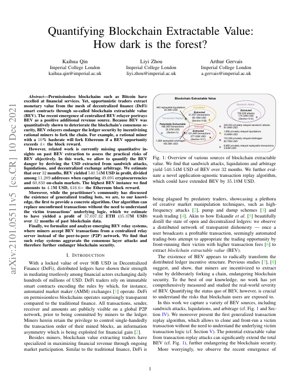
Our analysis spans 32 months of blockchain data, covering 49,691 cryptocurrencies and 60,830 on-chain markets. The total extracted BEV amounts to $540.54M distributed among 11,289 addresses.
BEV Distribution by Type:
- Sandwich Attacks: 750,529 attacks yielding $174.34M
- Liquidations: 31,057 transactions yielding $89.18M
- Arbitrage: 1,151,448 transactions yielding $277.02M
3. Technical Framework
3.1 Generalized Trading Bot Algorithm
We introduce the first concrete algorithm for generalized trading bots that can replace unconfirmed transactions without understanding the victim transactions' underlying logic:
Algorithm: Generalized Transaction Replay
Input: Pending transaction pool T, Gas price G
Output: Profitable transaction sequence S

1. Monitor mempool for incoming transactions T_i
2. For each T_i, simulate execution and estimate profit P_i
3. If P_i > threshold θ:
   a. Construct front-running transaction F with gas G' > G
   b. Construct back-running transaction B
   c. Submit sequence [F, T_i, B] to network
4. Repeat for all profitable opportunities
This algorithm yielded an estimated profit of 57,037.32 ETH ($35.37M USD) over 32 months.
3.2 Mathematical Formulation
The profitability condition for miners to fork the chain can be expressed as:
$$P_{BEV} > \frac{R_{block}}{\alpha} \times C_{fork}$$
Where $P_{BEV}$ is the extractable value, $R_{block}$ is the block reward, $\alpha$ is the miner's hashrate proportion, and $C_{fork}$ is the forking cost. For Ethereum, a rational miner with 10% hashrate will fork if BEV exceeds 4× the block reward.
4. Experimental Results
4.1 BEV Extraction Statistics
Our analysis reveals staggering BEV extraction figures:
- Highest single BEV instance: $4.1M USD (616.6× Ethereum block reward)
- Privately relayed sandwich attacks: 240,053 attacks yielding $81.04M
- Privately relayed arbitrage: 110,026 instances yielding $82.75M
- Transaction replay potential: 188,365 transactions with $35.37M extractable value
4.2 Security Implications
The concentration of BEV extraction creates significant consensus layer risks. Centralized BEV relay systems further aggravate these risks by creating centralized points of failure and coordination.
5. BEV Relay Systems Analysis
Emerging centralized BEV relay systems represent a fundamental shift in BEV extraction dynamics. These systems:
- Create centralized coordination points for BEV extraction
- Increase miner incentives for chain reorganization
- Reduce transparency in transaction ordering
- Potentially enable larger-scale consensus attacks
Our analysis shows that relay systems captured significant BEV value: 240,053 privately relayed sandwich attacks ($81.04M), 1,956 privately relayed liquidations ($10.69M), and 110,026 privately relayed arbitrages ($82.75M).
6. Future Applications & Directions
The BEV landscape continues to evolve with several critical developments:
Technical Countermeasures
- Fair sequencing services and commit-reveal schemes
- Threshold encryption for transaction privacy
- MEV-aware consensus mechanisms (e.g., Ethereum's proposer-builder separation)
Regulatory Considerations
- Classification of BEV extraction under securities laws
- Anti-front-running regulations for DeFi protocols
- Transparency requirements for miner extractable value
Protocol-Level Solutions
- Automated market maker design improvements
- Time-based transaction ordering
- Decentralized block building markets
7. References
- Qin, K., Zhou, L., & Gervais, A. (2021). Quantifying Blockchain Extractable Value: How dark is the forest?
- Daian, P., et al. (2020). Flash Boys 2.0: Frontrunning, Transaction Reordering, and Consensus Instability in Decentralized Exchanges.
- Torres, C. I., et al. (2021). Frontrunner Jones and the Raiders of the Dark Forest: An Empirical Study of Frontrunning on the Ethereum Blockchain.
- Zhou, L., et al. (2021). High-Frequency Trading on Decentralized On-Chain Exchanges.
- Eskandir, S., et al. (2022). The Distributed Network of Transparent Dishonesty.
- Buterin, V. (2021). Proposal for mitigating MEV in Ethereum 2.0.
- Goldman Sachs Research (2022). DeFi and the Future of Finance.
- IMF Working Paper (2022). Decentralized Finance and Financial Stability.
Expert Analysis: The BEV Security Crisis
一针见血
This research exposes a fundamental flaw in blockchain's economic model: BEV isn't just opportunistic profit-taking—it's a systemic threat that makes rational miners into potential attackers. The $540M extraction figure is alarming, but the real story is the $4.1M single instance that's 616x the block reward—proof that the incentives for chain reorganization are already dangerously high.
逻辑链条
The causal chain is terrifyingly clear: transparent mempools → identifiable profitable transactions → automated front-running → centralized relay coordination → miner incentives to fork. Like the CycleGAN paper demonstrated domain transformation, BEV transforms honest miners into extractive actors. The mathematics don't lie—when BEV exceeds $P_{BEV} > \frac{R_{block}}{\alpha} \times C_{fork}$, security collapses.
亮点与槽点
亮点: The generalized trading bot algorithm is a breakthrough—it demonstrates that BEV extraction can be automated without understanding transaction logic, creating a scalable threat. The 32-month dataset provides undeniable evidence of the problem's scale.
槽点: The paper understates the regulatory implications. Like the Financial Stability Board's warnings about shadow banking, BEV represents a parallel financial system with zero oversight. The centralized relay systems are recreating the very intermediaries blockchain aimed to eliminate.
行动启示
Protocol teams must implement MEV mitigation NOW—not later. The proposer-builder separation in Ethereum 2.0 is a start, but insufficient. We need encrypted mempools, fair ordering services, and economic disincentives for extraction. Regulators should treat centralized BEV relays like dark pools—with transparency requirements. The forest isn't just dark; it's actively predatory, and the trees are learning to hunt.